Wednesday, April 12, 2017

Week 23

As our Essentials guide puts it, "Congratulations and Amen!" You and your students have worked so hard this year and I hope you all have a greater understanding of the English language! It has been an honor to work with you and your students!

Can't wait to see everyone's presentations next week!


Tuesday, April 11, 2017

Week 22


This week in class, we will be practicing our presentation for the End of the Year Ceremony and working out any kinks. :) I will prepare sentences/diagrams/mad libs, etc for the kids. We will also make time to answer any questions and troubleshoot any points that need to be clarified. 

Looking forward to it!

Friday, March 31, 2017

Week 21

There is a new webinar just posted to the forum titled "Foundations to Challenge" and it focuses on the stage we and our kids are in right now. Go to CC Connected, then "Learning Center" then "Cultivating Classical Parents". There are a lot of good webinars there made just for us. 

Hope you all have a great weekend!

-Jenna

Monday, March 27, 2017

Week 20

Hi!

Wanted to include some of those Bibliography resources we discussed:

https://owl.english.purdue.edu/owl/resource/747/01/

There are a LOT of specific sections on the left you can click. For example, we had a question about which publication date to go with, if there is more than one...the original date should be uses.

 Also, I thought you might enjoy this link to Purdue's page about appositives:

https://owl.english.purdue.edu/owl/resource/596/01/

Thanks for all the work you do with your kiddos! We only have a few weeks left!

Jenna

Monday, March 20, 2017

Wrapping up Week 19

As we come into the home stretch for Week 19 and prepare for Week 20, discuss and copy Chart O. Go through a couple of analytical task sheets and remember to have a dialectic discussion during these exercises. This is a good time to answer any questions or clarify definitions for your student. 

For writing, we are in Lesson 25. We reviewed the basic essay model and intro/conclusion structure, then learned about a dramatic open-close: the very short sentence (p. 173). There is a lot of leeway this week. Y'all can either do the exercise in Lesson 25 and write intro and conclusion for your Knights paper (steps on p. 172)...or focus on Faces of History and try to get your topics outlined. We are doing the latter. 

As always, let me know if you need anything. I'm praying for you all as our families deal with different issues, and, of course, as we educate our children and build their character on a daily basis. 

Jenna

Monday, February 20, 2017

Week 16


Hi Essentials Parents!

Please let me know if you need anything. Your Essentials and IEW book have everything you need, but I know it can be cumbersome to find what you need, sometimes. Feel free to text me anytime. If I don't immediately know the answer, I'm really good at finding the answer. :)

Jenna


Monday, February 6, 2017

Week 15

I hope you guys are having a great Monday and hope to see you tomorrow night at my house at 6:00 pm for our Unit 7 DVD viewing. I'll be making soup/casserole. If you'd like to bring something, feel free. 

Wednesday, February 1, 2017

Faces of History Timeline

Faces of History 
A five-paragraph research paper

Phase 1: Choose historical figure. 
February 2nd

Gather books that discuss your historical figure. Use library books, timeline cards, the Story of the World books, history books, or the Internet. 

You will need a minimum of 3 books/sources. 

Phase 2: Brainstorm, Research
February 9th:

Review your sources. Brainstorm to decide on the 3 topics/themes you’d like to discuss in your paper.
Have your mom or dad approve these topics before proceeding.
Here are some suggestions:
Their childhood, family, education
Special skills/knowledge
The thing that they are famous for doing or accomplishing
The thing that they invented or discovered
Their adult life/unusual things they did or things that happened to them
How this person affected the rest of history or science / how people think of him/her today

The three themes or topics that I think I will write about are:

________________________, __________________________________, and _____________________

Phase 3: KWO
February 23rd:

Next, take notes on the first theme or topic. This will become body paragraph #1. Take notes from at least 3 sources. Stop and think: what bit of info would be interesting to start off with? What should you save for last? What notes are about the same kind of thing? Is there anything that isn’t really related to this theme? Now, thoughtfully arrange the notes into the best order you can work out. This will be your Fused Outline. 


Continue Research and KWO, Thesis Statement
March 9th:

Repeat the process for your 2nd and 3rd themes or topics. 

Stop and Think. Do you still think these are the best 3 choices? If not, or if one is really short, you can change the theme or topic.  Do you need to find more information? You can look again for more info if you need it. Think about the order…what order would be most exciting? Save the biggest and best for the last.

Now, write a sentence that mentions each of the three themes or topics. This is called a thesis statement. Be sure to mention the 3 themes in the order in which they will appear in your report.      
Ex: Archimedes (insert their name) experienced a unique education, lived a life full of accomplishments, and died a tragic death (insert Topic A), (insert Topic B), and (insert Topic C).
Thesis statement: ______________________________________________________________________

_________________________________________________________________________.

Phase 4: Write the Rough Draft of the Body Paragraphs
March 23rd:

Look at the fused outline for Topic A. Next, brainstorm and use the thesaurus to get some good adjectives and –ly words and metaphors and similes. Add these into your KWO. Write a rough draft of this paragraph. 

Repeat this process with theme/topic B and C. The third theme is the most exciting theme, so spend some extra time on this one.  Make sure you brainstorm some good adjectives and –ly words and metaphors or similes. Write the rough drafts.

Go back through all 3 body paragraphs and make sure all paragraphs have all the dress ups according to the FOH Checklist 
provided by your tutor.


Phase 5: Introduction/Conclusion, Openers
March 30th:

Read your paper aloud to your mom or dad and see if they understand it. If anything is confusing, re-work the sentence until it is just right.

Follow the directions from Lesson 23 in MHBW for writing Introduction and Conclusion paragraphs. Add a dramatic opener (hook) to your introduction.

Create a title from the last sentence of the conclusion.
Type or write out the paper very neatly. 

Begin thinking of a way you can dress to help us remember something about the character. Make a shield, a hat, a costume, carry something symbolic of the person, bring in something that he/she invented. Get creative, but it shouldn’t cost a lot of money. Use poster board for hats or shields or swords.


Phase 6: Bibliographies and Reviewing Checklist
April 6th
Using Lesson 30, type up a bibliography page. Use page 249 as a guide.
Complete and polish your final paper. (You don’t have to label the dress-ups on the final…you can use your rough draft to check off dress-ups and complete checklist.) 

Prepare your speech to perform for the class on April 20th. Students may choose to read their research reports directly from their papers, or they may choose to present their report as a first person narrative. This is a more advanced step.  Either way is fine. We will be devoting most, if not all, of our Essentials time to hearing the “Faces of History.”

Complete your costume. Practice your presentation.


Phase 7:  Present “Faces of History”
April 20th, the Big Day!
Everyone will be sharing (in costume) his/her Faces of History oral presentation.


Friday, January 27, 2017

Week 14

Good morning, ladies!

I know I find a lot of peace in this verse, especially as a homeschooling mom. When I first began our home learning journey, I definitely had some anxiety. What if I don't teach them everything they need to know? What if  I don't provide the right opportunities? But I was putting all the responsibilities on myself instead of sharing it with the greatest Teacher.

This week, try to identify active and passive voice while reading with your child. Also, look for imperative and complex sentences. Remember, the songs are a great resource for memorizing charts and they serve double duty for memorizing foundations grammar, too. 


 Please let me know if you have any questions!

~Jenna


Tuesday, January 24, 2017

Week 13

I thought we had a great first week back to class! The kids had good recall and I think we are off to a great beginning to the second half of the year!


Before we meet Thursday:


  • Be sure to complete a couple of Analytical Task Sheets with the new sentence pattern (p. 213-218), especially since we ran out of time to do one in class. 
  • Review the shaded area of Chart M: Complex Sentences" that we looked at in class. Focus on recognizing and understanding this pattern. 
  • Review previous charts with oral drills. 
  • Complete KWO's that we started in class for multiple source research project. Complete fused outline and complete paragraph. We will read these in class, if the students are willing. 
  • Follow Lesson 18 checklist on p. 125 for list of dress-ups, etc.
  • Begin looking for sources for your Faces of History paper. Library books, timeline cards, Story of the World books, or the Internet (although internet sources should be carefully selected for credibility...this is an excellent time to have a talk with your student about credible internet sources and how to select them). 


Faces of History

Carl - Martin Luther
Caroline V. - Joan of Arc
Caroline S. - Queen Elizabeth I
Stella - Empress Adelaide of Italy
Tripp K. - Alfred, the Great
Trip S. - Ivan, the Terrible
Selby - Mary, Queen of Scots

Hope you have a great day!

P.S. I'm really going to start sending these out Thursday after class instead of halfway through the week. :)

Jenna


Wednesday, December 7, 2016

Faces of History and Break Activities

Hi Essentials Parents!

On Week 12, we discussed our Faces of History Project. For this project, each student chooses one historical figure (preferably from the Medieval Period) and writes a 5-paragraph essay about that person's life.  It is fine to pick someone for your report who is not on this list. Once your child chooses someone, email me your choice. We will try to not double-up on figures. 
Once you have chosen a person, think about 3 topics you want to focus on. Ideas are: childhood, family, skills, battles, education, discoveries, writings, and beliefs. Was he/she a ruler? What were some accomplishments and hardships? How did he/she die? What do people think of him/her today or do we still use their ideas today? Etc....
You will need 3 different sources, so start finding them now. Timeline cards, children’s storybooks, and reference books from the library are good resources. You may use one Internet source with parent approval.
Moms, please read page 169-170 in the student’s IEW book for a brief overview of the 5-paragraph essay. We will spend plenty of time working together on this project in class and at home over the coming weeks. This Faces of History project will begin on Week 13 and will conclude on Week 24 with your presentation to the class. When your report is all finished, you may choose to dress up as your historical person and read to our CC Community at our final banquet (April 25).

Faces of History Ideas for Cycle 2 
Eric the Red
Leif Ericsson
St. Francis of Assisi
Theodoric the Ostrogoth
St. Benedict
Pope Gregory I (Gregory the Great) 

Clovis
Justinian
Harun al-Rashid
Egbert the Saxon
Rollo the Viking
Henry the Fowler
Canute the Great
El Cid
Edward the Confessor
Peter the Hermit
William Tell
Tamerlane
Frederick Barbarossa
St. Dominic
Edward the Black Prince
Louis IX
Geoffrey Chaucer
Thomas Becket
Thomas Aquinas
Erasmus
Jan Hus
John Wycliffe
Fra Angelico
The poet Dante
Joan of Arc - Caroline Vermilyea's choice
King Richard the Lion-Hearted 

Eleanor of Aquitaine
Henry II
Genghis Khan
Kublai Khan
Marco Polo
Prince Henry the Navigator Magellan
Christopher Columbus
King Ferdinand of Spain 

Queen Isabella of Spain 
Suleiman the Magnificent 
King Alfred (the Great)
Mansa Musa
English King John
Gutenberg
William the Conqueror 

Martin Luther  - Carl Barber's choice
Bartolomeu Dias
John Cabot
Vasco Da Gama
Czar Ivan the Great
Charles Martel
Pepin the Short
William Wallace
Robert the Bruce
Shakespeare 
Michaelangelo 
Donatello
Leonardo Da Vinci 

Nicolaus Copernicus 
Saladin
William of Ockham (Occam) 
Roger Bacon
Muhammed
Pope Urban II

Pope Innocent III 
Francesco Petrarch 
Mehmet the Conqueror 
Theodora
Lorenzo de Medici 
Vlad the Impaler 
Maimonides
Averroes ibn Rushd 

Brunelleschi
Edward I (Longshanks) 

Otto the Great Godfrey of Bouillon 
Saint Ludmilla
Osman I
Shen Kuo
Pope Leo IX (1002-1054) 

Charles the Wise
Henry V
Duns Scotus
Boethius
Guy de Chauliac
Giovanni Boccaccio 

Hildegard of Bingen
Pope Pius II
Margaret of Anjou 

Brunhilde
Catherine of Siena 

Empress Adelaide
Richard III
Elizabeth of York
Charles VII
Hrotsvitha of Gandersheim 

Julian of Norwich
Margery Kempe


I also wanted to give you some ideas of how you could brush up on your grammar and writing skills over the break. Here are some fun ideasI found online:


One review game is called Wipe Out. Look through your EEL guide and write some of the terms on a whiteboard. Have your child give definitions or examples of each one and erase them as you go. You might set a timer and see how many she can get erased in three minutes. You can blindfold her, spin her a few times, and have her stick a post-it note on the board to choose one. 


Or how about some Jenga? You can find all the definitions on the Essentials tier of CC Connected. Just print them off, cut them up and tape them on the blocks. 


Of course, Bingo is an easy game to put together. Print a blank bingo card and write the answers to any kind of questions that you think would help reinforce the material. I like to call it VINCO (I conquer) just to throw in some Latin. 


Another way we review the parts of speech while also working on writing skills is by narrating, or telling back, a short section of something you're reading aloud. The Schneitmans do a lot of narrating. It can be anything! Then hand them the book and have them identify different parts of speech. You could also brainstorm for quality adjectives and -ly words. 


One of the ways we have worked with the sentence patterns was by choosing one of our favorite photos and writing sentences incorporating the first four patterns that we are learning. I printed them out and then she parsed, diagrammed, and wrote down the pattern. This was fun.


Another way to think about the sentence patterns and actually write them is for your child to make some up about what she's currently reading. This is a higher thinking skill because not only is she recognizing the pattern, she is putting what she knows into practice. As you can see, she doesn't always get them correct. But she's learning!


To develop excellent writing skills, excellent literature needs to be read. Why not take some time over the holidays to read a few great books together?  By becoming familiar with different great authors and various genres, we increase vocabulary and recognize different styles and techniques. I'm all about using what we read as the jumping off point for writing assignments. 


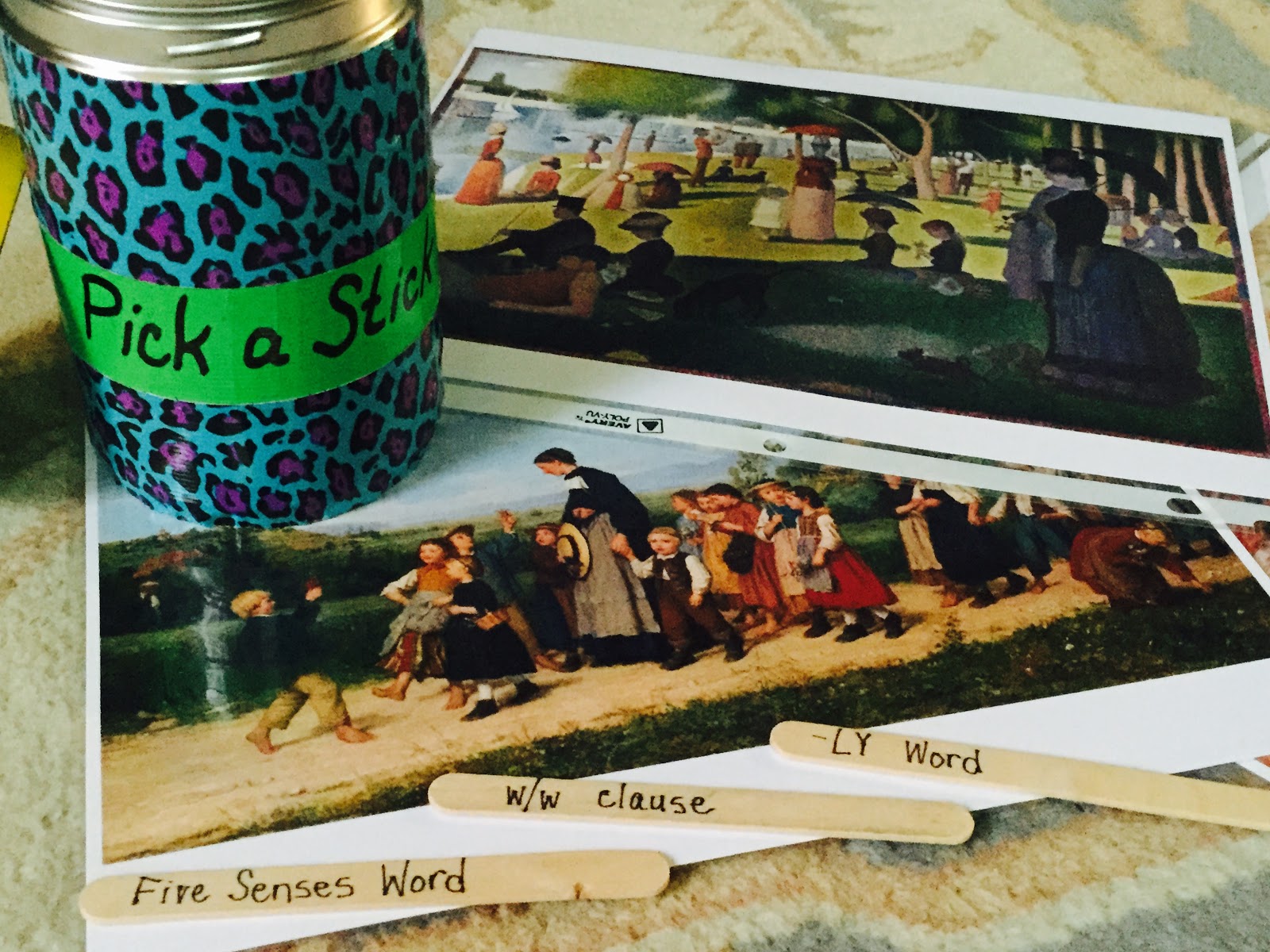
I also take every opportunity to mix in picture study. Pick-a-Stick lets the child create unique sentences about a particular work of art using dress-ups and stylistic techniques. There are numerous sites where famous artworks are available to download for free. The sticks can have prompts written on them to guide the sentence creations. I love this game; it may be my favorite.


I like to teach punctuation as we read. I think it makes much more sense when seen in the context of a book. Project Gutenberg has all the old classics available to download making it possible to print sections of books. I look up some literature that we are reading and print out a favorite selection. We read it, look and circle all the punctuation; discussing punctuation rules as we go. I then print it again, removing all the punctuation. We work together to replace all of it. I let her do the ones she knows on her own; always adding a new one following Pudewa's EZ+1 motto.


And using a whiteboard always makes everything a little more enjoyable.


Listening to audible books is a great family activity. You can do this while baking cookies or cuddling up by the fire with hot chocolate. We are currently listening to Swiss Family Robinson. Free audiobooks are available with the Librivox app or at Librivox.org. Some Librivox audiobooks are on You Tube. Audible.com also has affordable audiobooks. 


Select a few paragraphs to practice keyword outlining as demonstrated in Units 1 and 2. Take a story from history or an Aesop's fable and retell it using the structure of Unit 3. You can also help your child write a short report, Unit 4, about something related to one of the science sentences memorized so far. Practicing this assignment will help as we move on to our research papers and Faces of History papers.


I encourage you to spend some time over the break to pour over Andrew Pudewa's thoughts in the writing curriculum (Teaching Writing: Structure and Style). He's got great stuff and remember, you paid for all this curriculum so take advantage of it. There is also great info at IEW.com including great podcasts you can listen to while making dinner. 


I love how the Classical model invites us to be creative and tailor the curriculum to meet our individual child's needs. Enjoy the break and make learning English grammar and writing a natural part of each day. If you need anything, please let me know. 


-Jenna


Thursday, November 10, 2016

Week 11


So sorry I missed you all this week. I had a pretty good day of rest, so hopefully I'll be back to normal tomorrow. I'm attaching our take-home sheet at the top and what follows is basically my lesson plan for class today. Please let me know if you have any questions. 

Hope you have a great weekend!


Grammar

 Review - See attached crossword puzzle to print if you'd like

  1. Linking Verbs.
    1. Definition: A linking verb makes and assertion by joining two words. 
    2. Sing Chart C Linking Verbs – The Ants Go Marching
    3. (feel, become, remain, taste, seem, appear, look, sound, stay, smell, grow, am, are, is, was, were, be, being, been
  2. So a linking verb must be present in 2 of our sentence patterns – S-Vl-PN (Subject, Verb linking, Predicate Nominative) and S-Vl-PA (Subject, Verb linking, Predicate Adjective). If you see a linking verb, you will know that you have one of these two following it.
  3. Predicate Nominative – this is the next thing we must know.
    1. Definition: A predicate nominative is a noun or pronoun that follows a linking verb and renames the subject. 
    2. So let’s define a noun: A noun names a person, place, thing, activity, or idea. 
    3. And a pronoun: A pronoun replaces a noun in order to avoid repetition. 
  4. Predicate Adjective – 
    1. Definition – An adjective modifies a noun or a pronoun by describing, qualifying, or limiting.
      Adjectives answer the questions: What kind? How many? Which? Whose?
  5. So if we are looking for a word following a linking verb then this should be pretty easy to find. Then we just have to determine if it is a noun/pronoun or an adjective. 
  6. Examples: 
    1. Jesus is Holy.
    2. The bear is a carnivore.
    3. The boy is kind.
    4. Our Lord is God.

New Grammar

  1. Compound Sentences – remember that a Compound sentence has a FANBOYS and contains 2 or more independent clauses. 
  2. And we have talked about Compound Declarative sentences – the just declare something or give information. It’s easy to turn a declarative sentence into an exclamatory sentence. What does an exclamatory sentence do? It exclaims something. So we just add an exclamation point on the end and poof – we have a compound exclamatory sentence.
  3. Examples:
    1. Jesus is Holy!
    2. The bear is a carnivore!
    3. The boy is kind!
    4. Our Lord is God!


Writing

Cover 3SSS – Short, Staccato Sentences pg. 113

The name 3SSS stands for short, staccato sentences. The 3sss is simply the use of three short sentences (no more than five words each) in a row. Using short sentences in the middle of longer sentences can be a powerful way to draw attention to the short sentences, so use short sentences for important parts of a story. 

Sample: The dragon terrorized the town everyday. It swooped over the city. It spit fire. It left devastation. 
Sample from Selby's Faces of History paper last year: She was devastated. She vowed revenge. This started her pirate life. 

~JENNA


Wednesday, November 9, 2016

Essentials Week 10


I wanted to take a moment to discuss the Essentials portion of CC Connected with you all. Just like there are resources for Foundations on CC Connected, there are also tutorials and file sharing for Essentials. For example, there are documents including daily checklists for Grammar and Writing. If you've been struggling with a daily schedule for Essentials class, this might be a good resource. There is a separate subscription fee for the Essentials portion of CC Connected, but it might be worth a look. I'd be happy to log on during Community Day, so you could browse the site, if you'd like.

Praying you are all at peace with your schooling and with the world around us this week. May God give us focus on the important things and let us cast aside the rest. As I tell my kids...let's love what God loves.

~Jenna

Monday, October 31, 2016

Week 9


Work on memorizing the linking verbs, so they can say/sing them on their way in to class this week.

*To the tune of Mary Had a Little Lamb

Feel, become, remain, and taste,
Seem, appear,
Look, sound, stay,
Smell, grow, am, are, is, was, were,
Be, being, been

For Writing:
~ Information about quality adjectives is found in:
1. AHBW book lesson 16.
3. SRN pages 28-34,77.

~ The recommended text is in lesson 14, but use any reference text

~ Take a section from a book you're reading. Identify the nouns and write in quality adjectives. This can also be done with verbs and adverbs and strong verbs. Do this
over several days instead of doing the writing assignment, especially if this is your first year. Use different colored pencils to make it more fun.


Monday, October 24, 2016

Week 8


I hope you guys had a great break! We had a nice family trip and are coming home tomorrow. 

We missed several of you in class on our last day. I'm including several things you can go over at home if you want to catch up. 

We went over Lesson 8 in our EEL guide. 
Our new part of speech was "prepositions" (chart J).
We also worked on compound, interrogative sentences. 
We went through "Charlemagne-Part 2" in our IEW book. 
No new dress-ups, but we wrote our KWO and paragraph together on the board. 
Definitely review Chart J, if you can. 


Here's a fun article about 20 English words we commonly misuse and how to properly use them.
http://qz.com/432285/20-misused-words-that-make-smart-people-look-dumb/

I look forward to seeing you all on Thursday!


Tuesday, October 11, 2016

Week 7

In the beginning was the Word, and the Word was with God, and the Word was God. He was in the beginning with God. All things were made through Him, and without Him was not any thing made that was made. John 1:1-3

Good morning, ladies! I included the above verse because it shows how God values language...so much that He refers to the one who became Jesus as "the Word". All things were created through "the Word", so words are powerful. Let's not grow weary in doing this good work of teaching our kids the intricacies of language. It has great value!

-You should be finishing up your paragraph on Charlemagne. Use checklist on bottom of p. 87

-Our new stylistic technique this week is the simile. 

-Try to review the Adverbs chart and the Nouns chart 

-Identify adverbs in your daily speech and reading

-Analytical Task Sheets begin on p. 129

Everyone is doing so great! Keep up the hard work! 


-Jenna


Tuesday, October 4, 2016

Week 6

Just a quick note. Wanted to include the School House Rock "Conjunction" song because it's fun.


At home: refer to pages 108-109 in your EEL Guide
My suggestions:
~ Copy and recite the charts.
~ Work through one to five sample sentences.
~ Look for the first two sentence patterns in your daily reading.
~ Identify conjunctions and compound sentences.
~ Optional: editing, punctuation, spelling exercises.
~ Visit the CC Connected Essentials Tier, if you are a member
~ Spend 20 - 30 minutes daily on this...no more.
~ Lesson 11 in IEW
~Write “Alfred the Great” paragraph
  • Highlight everything from checklist p. 84 (including words from topic sentence and clincher that tell the topic of the paragraph)
  • Strive to use as many stylistic techniques as possible, but don't let your kid be overwhelmed. If he/she uses a few, that will be fine. 
Also, if you have a set of multiplication flashcards, please bring those to class on Thursday.

Hope you are all preparing in case the hurricane comes our way. Kim will notify us all if there is any change in schedule, due to the storm. 

Have a great week!

Monday, September 26, 2016

Week 5

Grammar

-Review Charts A-F, as needed
-Point out Interrogative sentences in speech and as you read aloud
-Analytical Task Sheet, tasks 1-4 (shoot for 2 or 3 per week)


Writing

-Finish KWO for Lesson 10
-If time, write a paragraph (or 3) for the "Borrowing a Conflict" Lesson on p. 73
-New dress-up is "because clause"


Also, try to get some math drill practice in this week. My kids have enjoyed playing Multiplication War at home. This game is nice because all you need is a deck of cards. But any math practice that works for your kids will be great (flash cards, math board games, orally reciting times tables, copying times tables, etc.)

We will have our next DVD viewing Tuesday, September 27 at my house at 6 pm. 
I'll make some soup and tea we can all enjoy. 

See you tomorrow!